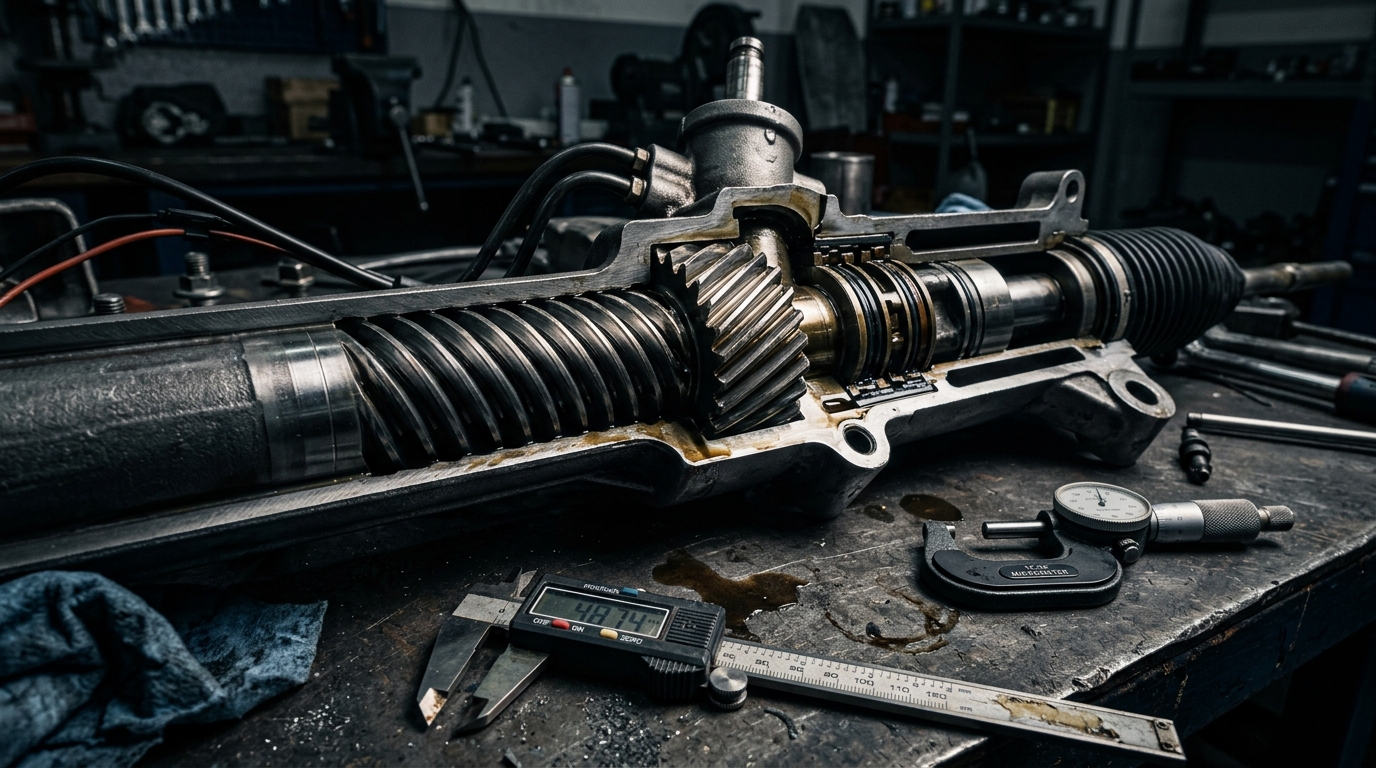
The rack-and-pinion steering assembly is among the most safety-critical mechanical subsystems in any automobile. Responsible for converting driver steering wheel torque into linear tire deflection while isolating road shocks, it operates under extreme hydraulic pressures exceeding 1,200 PSI during full-lock maneuvers.
Across West African road networks, steering racks endure continuous high-amplitude impact loading. Potholes, corrugations, and unpaved access roads drive repetitive shock waves through the tie-rod ends straight into the steering rack gear teeth. Over 60,000 km of rough road operation, the center 3 teeth of the rack—which engage during straight-line highway driving—suffer abrasive micro-pitting and surface fatigue wear.
When mechanics attempt to "recondition" worn steering racks in informal roadside workshops, the process typically involves simply replacing the outer rubber boots and wrapping leaking internal Teflon seals with thread tape. While this temporarily prevents fluid dripping onto the driveway, it leaves the gear backlash uncorrected and does nothing to restore the surface hardness of the rack shaft.
Under high tropical ambient temperatures (35°C to 42°C), hydraulic fluid viscosity thins rapidly. In a reconditioned rack with unhoned cylinders, the pressurized fluid slips past the piston ring, resulting in "morning sickness" steering heaviness, catastrophic steering shudder, and unpredictable loss of power assist in emergency evasive maneuvers.
Parts4Drive establishes clear categorization: Grade-A Tested Salvage (Tokunbo) units must pass hydraulic pressure bench testing at 1,400 PSI with zero internal bypass, while certified Tier-1 new replacements (brands like TRW, JTEKT, and Mando) are supplied with factory induction hardening. Mechanics can purchase with complete transparency regarding component lifespan.